Enjoy 5% Off Your first order
offers and home ideas.
{{ news.error }}


Help & Advice
Our Help & Advice section has everything you need to choose your electric blinds with confidence.
Why Electric blinds?
Remote controlled electric blinds are more than just an affordable luxury—they’re a smart way to elevate everyday living.
Measuring Up
Our step-by-step guides make it easy to measure accurately for perfectly fitting blinds.
How To Install
Smart design, simple setup—our electric blinds install as easily as standard blinds, no electricians required.

Made To Measure
In The UK

5 year Guarantee*

Free Samples

Smart Technology

Energy Saving
Search Results
Sorry, there were no results for that search, please try searching for somethign else.
Filters
{{slot.removeUnderscores(index)}}
How to Measure for Electric Blinds
At Powered Blinds, getting the perfect fit starts with accurate measuring. Our electric blinds are made to measure, and our clear, step-by-step guides make the process simple and stress-free. Whether you’re fitting blinds for windows, doors, or tricky spaces, we’ll help you measure confidently for a smooth, professional result.


windows


windows


windows
 Standard Window
If you want your window blind to fit inside, or to hang outside the window recess use our simple step by step guides and videos below to find out how.
Recess Size
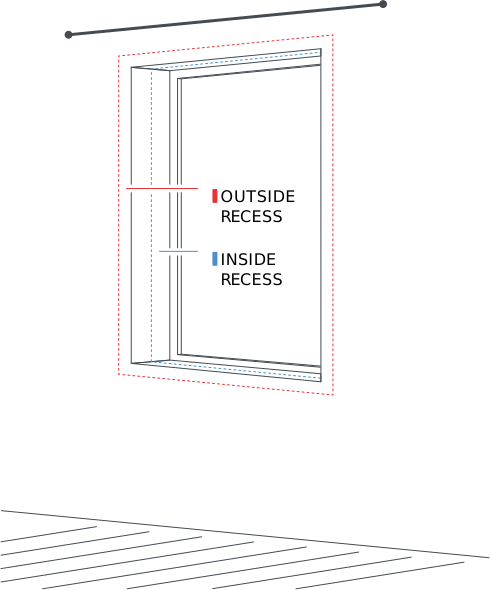
Inside Window Recess
This is the measurement you need to make if the blind needs to fit inside the window recess. Measure the width and the drop in three different positions ensuring you provide us with the smallest measurement.
We will make any necessary deductions to ensure the blind fits neatly within the recess of the window.
For roller blinds we only require you to measure the top width of your recess and provide this when placing your order.
Roller blinds
Please note that the actual fabric will be approximately 3-4cm narrower than the recess width depending on the blind ordered.
Blackout blinds
Our fabric experts recommend when ordering a blackout blind, you fit this outside the window recess using the ‘exact’ blind measurement thus ensuring as much external light as possible is blocked out.
Vertical blinds
The headrail is included in the drop of the blind therefore the louvres will be shorter than the drop.
Exact Size
Outside Window Recess
An exact size blind is also known as ‘pin width’ or ‘finished blind width’. This is the measurement you need to make if the blind needs to hang outside the recess overlapping the window. Decide how much you wish to overlap the recess at each side, we recommend at least 7.5cm at each side as well as the top and bottom so as to minimise as much external light as possible.
Measure the width and the drop in three different positions ensuring you provide us with the smallest measurement. We will not make any deductions from the measurements provided.
Roller blinds
Please note this width includes the mechanism of the blind and is not the width of the cloth.
Vertical blinds
The headrail is included in the drop of the blind therefore the louvres will be shorter than the drop.
 Angled Bay Window
Introduction
Before you start measuring, please select the correct head rail depth from the table on the righttable below. If you have window handles or vents that stick out from the window frame, measure how far these protrude and add this to the head rail depth.
This will be used as the measurement in step 1 below.
| Blinds Type | Depth (MM) |
|---|---|
| Aluminium Blind | 35mm |
| Roman Blind | 40mm |
| Pleated Blind | 40mm |
| Roller Blind | 50mm |
| Wooden Blind (25mm slats) |
60mm |
| Wooden Blind (27mm slats) |
60mm |
| Wooden Blind (35mm slats) |
60mm |
| Blinds Type | Depth (MM) |
|---|---|
| Roller Blind (Face Fix) |
70mm |
| Vertical Blind (Top Fix) |
73mm |
| Vertical Blind (Face Fix) |
73mm |
| Wooden Blind (50mm slats) |
80mm |
| Wooden Blind (64mm slats) |
80mm |
| Vertical Blind (Large Face Fix) |
91mm |
| Vertical Blind (Medium Face Fix) |
107mm |
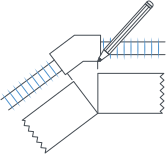
Cut 2 pieces of cardboard 300mm long and as wide as you calculated above. Remember to account for anything protruding from the window, such as handles.
For example if you want 35mm slats and also need to account for a 30mm protruding handle, you would use a depth of 90mm (60mm + 30mm).
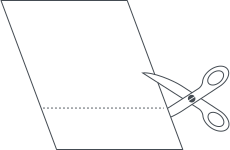
Slide the two pieces of paper towards each other aling the window sill of the bay until the two corners meet up.
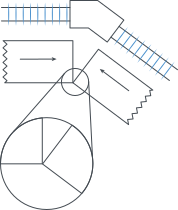
Using a pencil, make a small mark on the window sill at the point where the paper meets the window frame.
Repeat steps two and three for each corner of your bay window.
Measure between each set of marks you have made. This will establish the width of the blinds you will need to order.
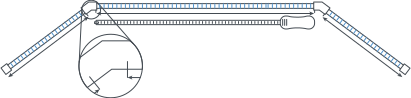
To establish your drop, measure from where the top of the blind will sit, down to where you want the blind to stop (normall the window sill).
When ordering the blinds on our website you should order them with an 'exact' measurement type.

 Boxed Bay Window
Introduction
Find the rail depth for your chosen blind using our handy table. Make a note of this before you start measuring.
Choose from the three fitting options. Then measure your bay windows with a metal tape measure, using the instructions for your chosen option.
If your side blinds are going to run up to a wall, deduct 5mm from your final measurements.
| Blinds Type | Depth (mm) |
|---|---|
| Aluminium Blind | 35mm |
| Roman Blind | 40mm |
| Pleated Blind | 40mm |
| Roller Blind | 50mm |
| Wooden Blind (25mm slats) |
60mm |
| Wooden Blind (27mm slats) |
60mm |
| Wooden Blind (35mm slats) |
60mm |
| Blinds Type | Depth (mm) |
|---|---|
| Roller Blind (Face Fix) |
70mm |
| Vertical Blind (Top Fix) |
73mm |
| Vertical Blind (Face Fix) |
73mm |
| Wooden Blind (50mm slats) |
80mm |
| Wooden Blind (64mm slats) |
80mm |
| Vertical Blind (Medium Face Fix) |
91mm |
| Vertical Blind (Large Face Fix) |
107mm |
Option 1
For this option, the front blind fits from corner to corner, with the side blinds installed up against the front blind. For your front blinds, measure the full width of the bay then subtract 15mm and choose 'exact fitting' when ordering.
Measure the width of each side blind seperately in the same way then deduct the rail depth from each to get your final measurements. The side blinds should then be ordered as 'exact fitting'.
Handles, openers and vents
If you have any obstructions protruding from the front window, measure how far they stick out past the window.
Option 2
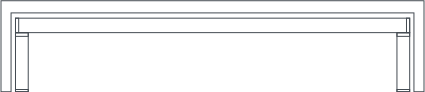
To make sure this is suitable for your window, check the size of your window frame, going from the corner of the bay to the start of the glass frame pane one the front and then the sides. If any of these measurements are smaller then the rail depth of your blind then your blinds will not cover the glass and there will be noticeable gaps. In this instance, we recommend you consider another fitting option.
In this style all three blinds meet in the corner of the bay without overlapping, creating an empty square space in the corners. Measuring is straight forward, just measure all three sections directly into the corners. Deduct the rail depth from the measurement for each of the side blinds and deduct double the rail depth from the measurement for the front blind. Finally order all as 'exact fitting' blinds.
Handles, openers and vents
Obstructions on the front of the window will reduce the width of the side blinds. Measure how far the obstructions protrudes past the window frame and deduct that from the side blind measurements.
Obstructions on the side windows will reduce the width of the front blind. Measure how far the obstruction protrudes past the side window frame and deduct that from the front blinds measurements.
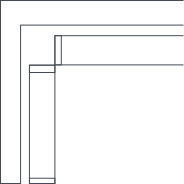
Option 3
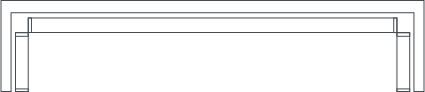
If your side windows are too small for the other options, then this will be the most suitable option for you. In this option, the side blinds continue into the corners and the front blind sits between them. Measure the sides into the corner then subtract 15mm, use this measurement to order both as 'exact fit'. Measure across the front then deduct double the rail depth and order as 'exact fitting'.
Handles, openers and vents
Obstructions on the side windows will reduce the width of the front blind. Measure how far the obstruction protrudes past the side window frame and deduct that from the front blinds measurements.
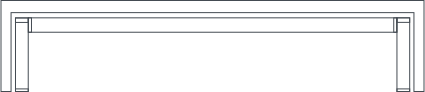
Important
Always check the widths in three places as you would for a regular refular recessed window. Bay windows are prone to movement and you may find that the width vary even if at first glance the windows look square. It is always the smallest of the three measurements that you should use.
Drop
This is the same for all three options. It will simply be from the point where the blind is being mounted down to the window sill. Remember that the head rail is included in the drop and that you will need a flat space of at least 50mm (5cm) to mount the brackets securely.
How to measure window blinds FAQs
For outside the window recess, alongside the above, add at least 7.5cm at each side as well as the top and bottom to minimise as much external light as possible.
The measuring process is easy, and the final product is often cheaper than pre-made blinds on the high street.


Powered Blinds offers a curated collection of smart electric blinds and control systems, designed to bring together modern design and home automation. Whether you're looking to enhance comfort, improve security, or streamline your living space, our innovative range has something to suit. We're always adding new styles and solutions—so if you don’t find what you need today, be sure to visit again soon.
Enjoy complete peace of mind with our five-year guarantee. We're confident in the quality and durability of our products, which is why every blind we offer is backed by a comprehensive guarantee—so you can buy with confidence, knowing you're covered for years to come.
Free delivery for orders over £199.00. For orders under £199.00 we only charge £9.95. Fabric Samples always ship free!

The world leader in producing reliable and hard wearing motors and control systems for the home.
Copyright © 2026 Interior Goods Direct Limited. All Rights Reserved.
Powered Blinds is a division of Interior Goods Direct Limited, suppliers of high quality home and commercial interior products.
Place of registration: UK, Registration number: 04966706, VAT Registration Number 817 3168 28, Registered office: Building 2, Colne Bridge Road, Colne Bridge Huddersfield, West Yorkshire, HD5 0RH